
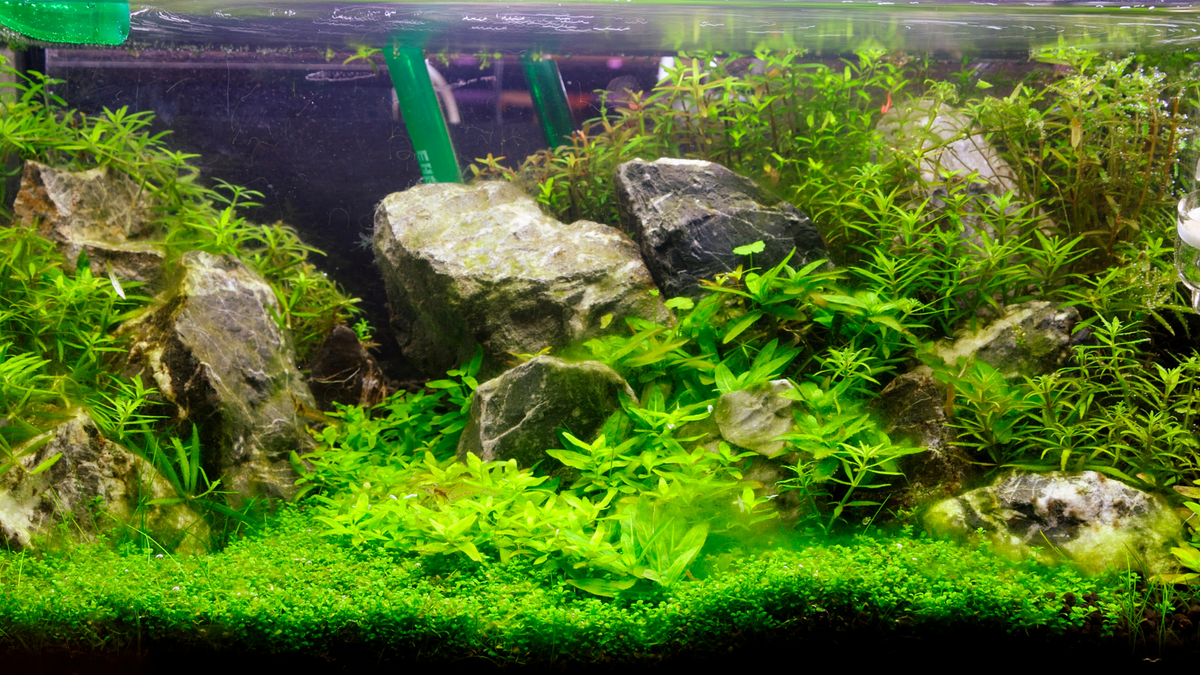
Carpet plants are low foreground species such as Glossostigma, Hemianthus callitrichoides and dwarf hairgrass that spread sideways into a dense green mat. For a thick carpet, plant small portions into a nutrient-rich substrate, give bright light, run pressurised CO2 on a timer alongside the lights, and trim often so the growth stays low and even.
Last updated: 6 November 2026
How to grow carpet plants in an aquarium
In this article, we want to explain the easiest methods for growing - and looking after a beautiful green carpet in your planted tank. With a few simple steps, growing carpet plants is not as difficult as it may seem.
One of the most common mistakes committed by hobbyists is related to root and plant growth. A common mistake is letting carpet plants grow too high, which, when trying to create a dense carpet, can become frustrating and, more often than not, results in the carpet plants being replaced by some typical foreground plants.
Glossostigma elatinoides (Glosso)is a great carpet plant found in New Zealand swamps. Known for its ability to increase and cover an area very well.
Hemianthus callitrichoides (HC Cuba) Is commonly used to grow a carpet area of a planted tank because of its size. Being so small, it creates a nice carpet, but the downside is that it is probably one of the most challenging plants to grow successfully.
Eleocharis parvula ( Dwarf Hairgrass) looks beautiful in a carpeted tank. It is a fast-growing Plant that can require trimming almost every week. One of the main appeals of this particular plant is its ability to look just like a beautiful lawn, transforming any planted aquarium.
To succeed in planting aquarium carpet plants or aquatic plants, in general, use a nutrient-rich substrate. Growing plants without the correct substrate can cause issues with the root system and even affect the rate at which your aquatic plants spread out. Aquarium carpet plants tend to be shorter, and instead of drawing nutrients from the water column, they pull more of their nutrients from the substrate via their roots. All good aquarium carpets have a very compact structure of the roots below. To avoid root compression, mix any powdered substrate with a more coarse soil and add the correct substrate level. Additionally, algae can become a problem in a planted tank when the growth rate is reduced.
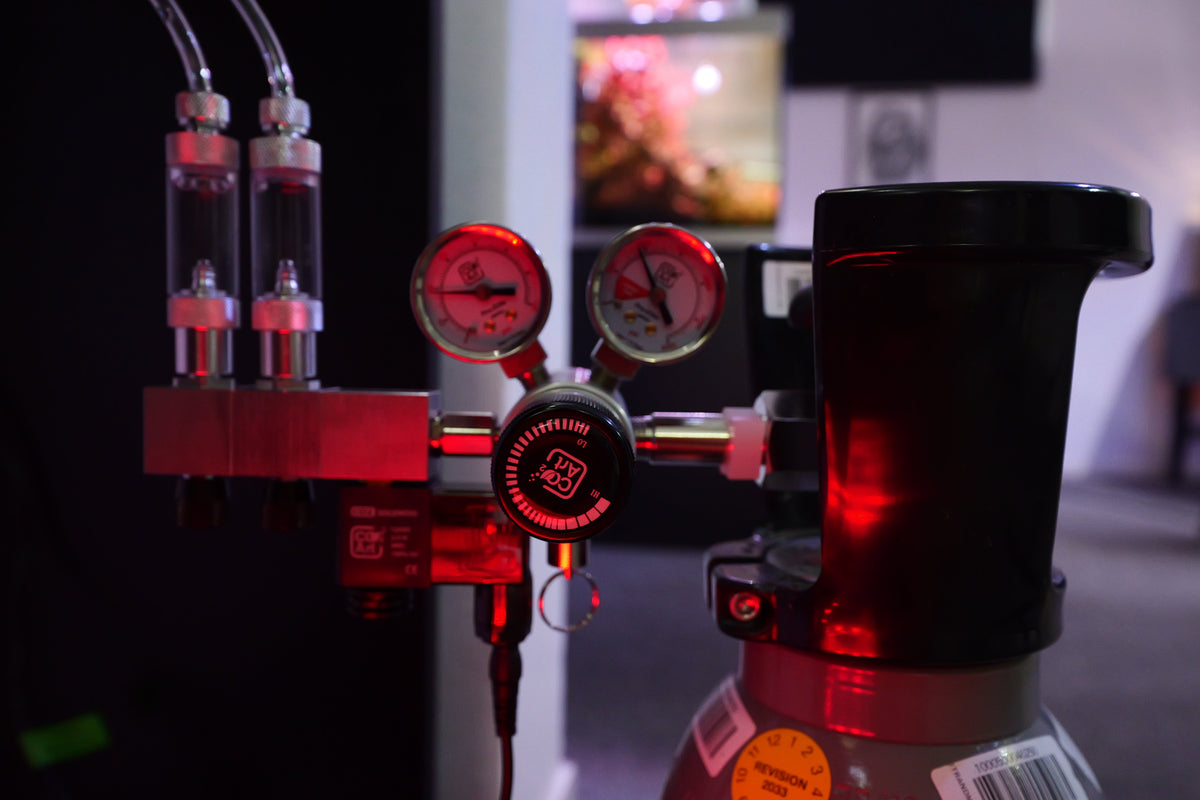
Another success element is providing enough co2 and an effective light unit. Using timers, you can easily create a steady and consistent daily pattern for both light and Co2, which makes life easier for you but also encourages continued and healthy growth for your new aquarium carpet and, of course, your entire planted tank. The most popular routine has your CO2 turn on one hour before your lights switch, and then your CO2 stop an hour before your lights go off. Doing this provides your planted aquarium with maximum CO2 during what is known as the 'photo period' (when lights are on).
New horizontal growth is dense. new individual plantlets spread quickly, almost in a grid pattern and fill up space quickly.
Maintenance
Regular maintenance of a fish tank carpet doesn't take up a lot of time. The trimming takes only five minutes, followed by two or three minutes to gather the cuttings.
If they are well-rooted, most carpeting plants are relatively straightforward (and very satisfying) to trim. By employing the help of curved aquascaping scissors, you can effectively shorten and shape any carpet plant. Furthermore, with most carpeting plants, the trimmings will float to the aquarium's surface, making removal easy. A small surface skimmer can help gather the cuttings from your aquarium plants straight from the surface, making it even easier.
Making sure you have the correct aquascaping tools will make your life much easier. The curved scissors are suitable for precision work, especially for small and more delicate carpet plant species such as Hemianthus callitrichoides (HC Cuba). Trimming well-rooted, larger plants such as Cryptocoryne or Staurogyne Repens with regular aquascaping scissors or even your fingertips (if you are gentle) is perfectly ok.
After trimming, your lush green carpet may look a little worn out but be assured, in a healthy aquarium, you will see a lovely carpet requiring trimming yet again within two weeks. Luckily, trimming your carpeting plants does not disturb the substrate, so it is not essential to perform a water change afterwards. Plants such as Eleocharis, Riccia, mosses, and other similar species also benefit from regular trimming. Keeping a close eye on your entire aquascape, looking out for new growth and older leaves, will guide you on where to trim each plant. Don't be afraid to cut your plants. Healthy plants and plants that may have had some damage due to algae will both benefit from trimming. It encourages new growth and will help to keep clean of detritus and other impurities that may promote an algae bloom. You can find out more about that in this BLOG.
Depending on the growth rate and liquid fertilizers routine, it's recommended to trim your carpet plants every 2-4 months. However, if your plants are overgrowing, they naturally tend to become overlapped, creating a lot of layers. When this happens, it is time to trim. If left to grow this way, the top layers will block the light from reaching the lower levels, leading to the lower-level plants perishing. In a new tank, it is recommended to avoid a good trim shortly after planting, especially with a carpeting plant. As long as you have the proper substrate, ph level, water temperature, and light and carbon dioxide levels, your new carpet plant will become a dense carpet in no time.
Remember that maintaining a healthy, thick carpet is not easy. Patience is essential, and time must be given to achieve anything. It is strongly advised that to achieve optimal conditions, carbon dioxide is necessary. The same generally applies to most foreground plants. By nature, they usually are shorter and will also require intense lighting. You can check out our co2 kits here - COMPLETE CO2 SYSTEM.
If you prefer to maintain a low-tech tank, we recommend avoiding carpeting plants and planting smaller plants that are more suited for a low-tech setup. Staurogyne repens and Dwarf Sagittaria are both, in fact, great low-tech carpeting plants. Planting them in a quality nutrient-rich substrate alongside some root tabs and regular liquid fertilizer will produce a nice carpet at a slower growth rate.
If opting for no CO2 injection, pay attention to the light unit capacity to avoid imbalance and unwanted algae growth.
Creating a dense and aesthetic carpet is not straightforward because carpet plants are usually delicate. On the other hand, when they are finally well-rooted, regular trimming of these aquarium plants is much easier. Combined fertilizing with micronutrients and CO2 will reward you with green and beautiful foreground.
The carpet plants in this article, at a glance
| Carpet plant | What this article says about it | Suits a low-tech tank without CO2? | Trimming the article mentions |
|---|---|---|---|
| Glossostigma elatinoides (Glosso) | Found in New Zealand swamps; spreads to cover an area well | Not mentioned; the article advises CO2 for a carpet | — |
| Hemianthus callitrichoides (HC Cuba) | So small it makes a fine carpet, and one of the most challenging to grow successfully | Not mentioned; the article advises CO2 for a carpet | Curved aquascaping scissors, for precision work |
| Eleocharis parvula (Dwarf Hairgrass) | Fast-growing, and looks like a lawn once it fills in | Not mentioned; the article advises CO2 for a carpet | Almost every week |
| Staurogyne repens | Named as a low-tech carpeting plant; larger and easier to handle once well-rooted | Yes, in a nutrient-rich substrate with root tabs and liquid fertiliser | Regular aquascaping scissors, or fingertips if you are gentle |
| Dwarf Sagittaria | Named as a low-tech carpeting plant; carpets at a slower growth rate | Yes, in a nutrient-rich substrate with root tabs and liquid fertiliser | — |
Frequently asked questions
How do you plant an aquarium carpet?
Split the pot into small portions of a few stems or plantlets and push each one into a damp, nutrient-rich substrate with tweezers, leaving gaps so the runners have room to fill in. Many aquascapers plant with the tank only shallowly filled, then fill it slowly to avoid floating the portions out.
What soil or substrate do aquarium carpet plants need?
A nutrient-rich substrate, because carpet plants feed mainly through their roots rather than from the water column. Their roots are short, so keep any sand or gravel cap thin enough for them to reach the richer layer below, and mix fine powdered substrate with a coarser grain so the bed does not compress.
Do carpet plants need CO2?
Most of the classic carpets — dwarf hairgrass, Glosso and HC Cuba — only form a tight, low mat with CO2 injection and strong light. Without it they grow slowly, stretch upwards towards the light and give algae the opening it needs. Staurogyne repens and Dwarf Sagittaria are the usual choices for a tank with no CO2 injection.
What are the fastest growing aquarium carpet plants?
Dwarf hairgrass and Glosso spread quickly once rooted, sending out runners that fill the gaps in an almost grid-like pattern. Both keep up that pace only with strong light and CO2 injection, and both then need frequent trimming. HC Cuba makes the finest carpet but is one of the hardest to establish, so it is a poor first choice.
Can you add carpet plants to an established aquarium?
Yes, but drain the tank to a few centimetres first or plant with a long pair of tweezers, and clear algae and detritus from the spot before you start. In an established tank the substrate is already settled, so press each portion in firmly and expect slower spread until the roots take hold.
How often should you trim aquarium carpet plants?
Trim as soon as the carpet starts growing in layers, because the top leaves shade the ones underneath and the lower layer dies back. A fast grower like dwarf hairgrass can need it almost weekly; a slower, well-balanced carpet often goes every 2-4 months. The cuttings float up, where a net or surface skimmer collects them.
Sources
- Plants of the World Online (Royal Botanic Gardens, Kew)
- New Zealand Plant Conservation Network — species fact sheets
- Tropica Aquarium Plants — plant database (the grower's own data, not a retailer listing)
- USGS Water Science School — pH and water
A dense, low carpet is the hardest thing in a planted tank to grow without CO2 injection — dwarf hairgrass, Glosso and HC Cuba all stretch upwards and thin out when carbon runs short, and the gaps they leave are where algae starts. Keeping the gas on through the whole photo period, with a solenoid on a timer, is what keeps that growth horizontal rather than tall. Our complete systems put the dual-stage regulator with solenoid, bubble counter, diffuser and a drop checker in one box, so the only thing left to buy is the cylinder — the in-tank version suits a tank without an external filter, the inline one a tank with a canister filter. See the product.
Share:
How to clear up a cloudy aquarium
Drop Checker: What Size, How Many, Will It Fit?